
How to Find a Restaurant or Café From a Photo
By Sam D. · · 7 min read
Short answer
To find a restaurant from a photo, check the original file for GPS, then look for the name on signs, menus, napkins, cups and receipts. If none shows, use the menu’s language and currency and the dish to pick a city, then match the room against photos of candidate places in Google Maps.
Find where your photo was taken
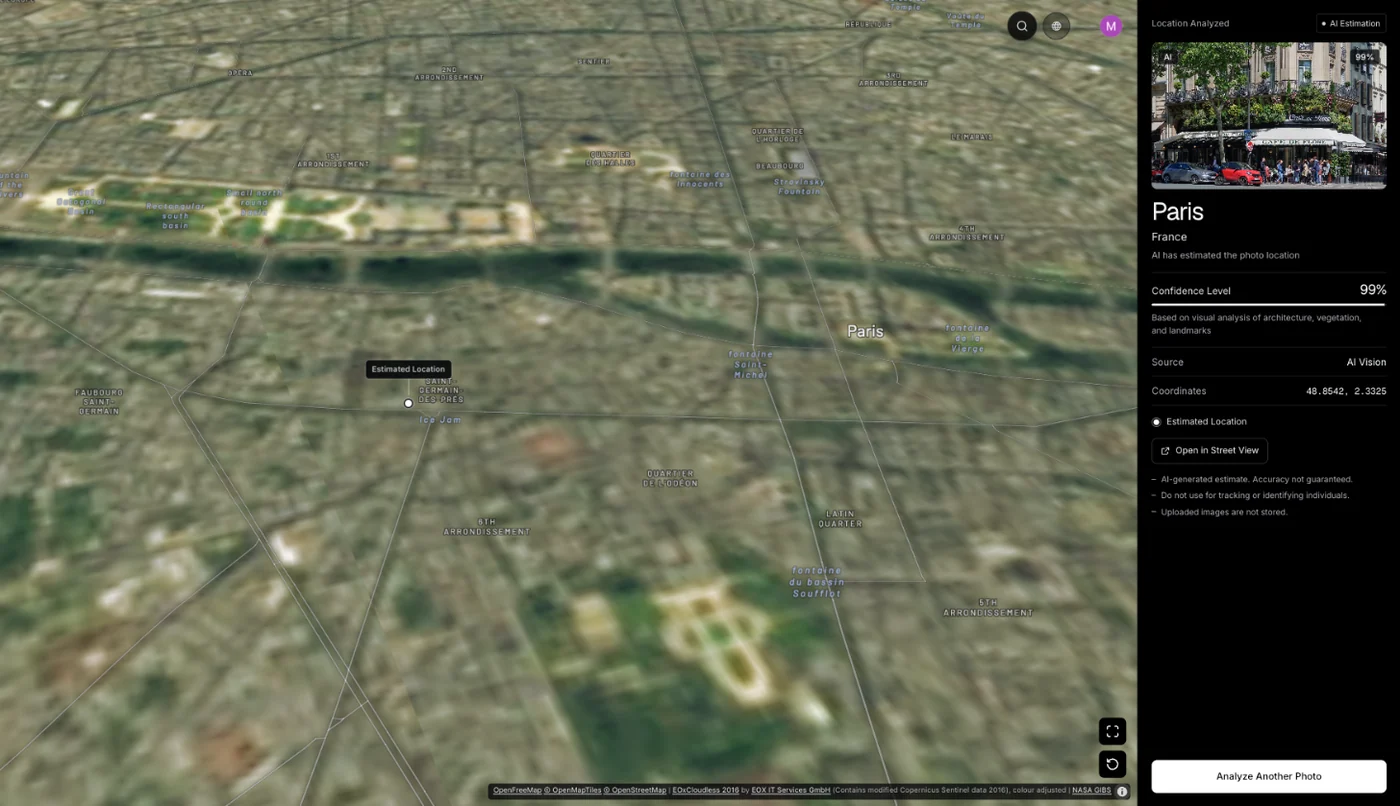
Upload a photo: GeoSpy AI reads its GPS data if it has any, and otherwise estimates the place from what it shows.
Most restaurant photos carry the answer somewhere in the frame: a name on the awning, the menu, a napkin or a cup. When it is missing, the room, the dishes and the language on the table narrow the search. For a starting point, a location finder for photos estimates the city from the picture; the steps below show how to find a restaurant from a photo and confirm the place.
This guide covers restaurants, cafés and bars. For any other picture, see how to find where a photo was taken; for a building’s exterior, the building clues guide.
Does the restaurant photo still have GPS data?
Sometimes. A photo straight from a phone with location on carries GPS coordinates, and a metadata viewer reads them in seconds. Food photos are usually shared through apps that remove that data; if the fields are empty, the name and the room are your evidence.
Open the original in a photo metadata viewer. Coordinates show where the phone was, so check what stands at that address. The capture date matters too: a café renovated since then will not match its current photos. If the fields are empty, why photos lose location when shared explains which apps strip them.
Where does a restaurant’s name hide in a photo?
On almost anything printed: the sign, the awning, window lettering, the menu, napkins, cups, sugar packets, receipts, takeaway bags and staff uniforms. Zoom in on each one; a partial name plus a city is often enough to search.
- Window lettering reads backwards from inside, so flip the crop horizontally before you search for it.
- Menus carry the name at the top and often an address, a phone number or a social media handle at the bottom.
- Cups, napkins and sugar packets are often branded, especially in cafés.
- Receipts print the business name and address, often with a phone and tax number: the most exact clue a table photo can hold.
Search the text in quotes, with the city. A few letters of a logo, the cuisine and the city can narrow Google Maps to a handful of candidates.
How do you find a restaurant from a photo of just the food?
Read the dish and everything around it. The dish suggests a cuisine, but the plates, the cutlery, the table and any branding identify the restaurant. Run the photo through Google Lens, then compare dish photos of candidate places in Google Maps.
A dish alone is a weak clue, because cuisines travel. UNESCO inscribed the art of the Neapolitan pizzaiuolo as intangible heritage in 2017, and Naples alone is home to about 3,000 pizzaiuoli, yet Neapolitan-style pizza is served worldwide. What pins down one restaurant is its plates, boards, tablecloths and anything with its logo.
Google Lens is the quickest test: its results can include similar images and websites with the same picture, so a dish the restaurant or a reviewer posted before may come back with the name. Then open each candidate in the Google Maps app, tap Menu on the info tab and tap a dish thumbnail to see that dish’s photos. Not every dish is listed, so check the photo gallery too.
What do the menu’s language and currency tell you?
They narrow the country. The menu’s script and language, the currency sign, the country code in a phone number and local customs on the bill all point to a region.
| What you see | What it points to |
|---|---|
| A currency sign such as €, £, ¥, zł or kr | The eurozone, the UK, Japan or China, Poland, Scandinavia and Iceland |
| A phone number starting +33, +39 or +81 | France, Italy or Japan; every country has its own calling code |
| “Coperto” or “pane e coperto” on the menu or the bill | Italy, where a bread-and-cover charge is nearly universal |
| Plastic or wax replicas of dishes in the window | Japan above all; restaurants in South Korea and China use them too |
Translate what you cannot read: the Google Translate app translates text in images on your phone, which turns a menu into dish names and often an address. For scripts and other national details, see how to identify a country from photo clues.
How do you match the room to a place on Google Maps?
List the fixed details: floor tiles, lamps, the counter, shelves, wall art and windows. Then open each candidate’s place page in Google Maps, go through the owner’s and visitors’ photos, and look for the same details. Ignore what changes easily, such as flowers and table settings.
- Step 1Build a candidate listSearch Google Maps for the partial name or the cuisine in the likely city.
- Step 2Open the photo galleryOn a computer, search for the place and click the large photo on the top left. Visitors’ photos show the room from many angles.
- Step 3Compare fixed detailsMatch two or three features that are hard to change: a floor pattern, a light fitting, the counter, a mural. If a window shows the street, confirm that view in Street View.
- Step 4Watch for chainsChains reuse one design in many branches. A match names the chain; the view, the floor plan or the street outside names the branch.
Can a location tag, a review site or the poster give the answer?
Often. A post’s location tag, caption, hashtags and comments frequently name the place, and review sites collect diners’ photos of the same rooms and dishes. For a public post, asking the person who posted it is often fastest.
Treat a tag as a claim, not a measurement: people tag the city, a landmark or the wrong branch, so check it against the room. Our guide to finding where an Instagram photo was taken covers tags and captions. A reverse image search can also find the same picture on a food blog or a review page that names the restaurant.
Can AI tell where a restaurant photo was taken?
It can estimate it. GeoSpy reads GPS from the file when it is there; without it, an AI model estimates the place from what the photo shows, such as signs, script, architecture and the street outside, and returns a location with a confidence score on a map. Use it to choose the city, then find the restaurant.
An estimate helps most when the photo shows a language but no name: knowing the city turns an open search into a short list. Upload the widest frame you have, since a window, a street or a facade gives the model more to read than a plate. Seeing the full result is a paid feature on the web. For how such models read a scene, see how AI geolocation works.
Frequently asked questions
- Can Google Lens identify a restaurant from a picture?
- Often, when the photo shows a logo, a sign or a dish that people have posted before. Lens returns similar images and websites with the same picture, which can lead to the restaurant’s page or a review.
- How do I find a café from a photo with no name in it?
- Use the room: list fixed details such as tiles, lamps, the counter and the view, pick the city from any text, and compare them with visitors’ photos of cafés there on Google Maps.
- What restaurant is this in a TikTok or Instagram video?
- Check the location tag, caption and comments first; creators often name the place there. Then pause on frames that show the menu, the sign or the street. See finding where a TikTok video was filmed for the video side.
- Can a receipt in the photo identify the restaurant?
- Usually. Receipts print the business name and address, and often a phone and tax number. Zoom in on the top of the slip; a partial name plus a street is enough to search Google Maps.
Sources
- Art of Neapolitan ‘Pizzaiuolo’ — UNESCO Intangible Cultural HeritageInscribed in 2017; the practice originates in Naples, home to about 3,000 pizzaiuoli.
- Add & explore dishes in Google Maps — Google Maps HelpIn the app, tap Menu on a place’s info tab, then a dish thumbnail to browse its photos and reviews.
- Search with an image on Google — Google Search HelpLens results can include similar images and websites with the image or a similar image.
- Food model — WikipediaFood replicas in restaurant windows, common in Japan and also used in South Korea and China.
Keep reading
How to Find Where an Instagram Photo Was Taken
Instagram strips photo metadata on upload, so the coordinates are gone before you see the post. What is left, what actually works, and where the limits are.
· 4 min read
Where Is This Building? 7 Clues That Give Its Location Away
Where is this building? Read architecture style, materials, roof pitch, windows, signs, street furniture and climate to place an ordinary building.
· 7 min read
The Best Reverse Image Search Tools, Compared
Google Lens, Yandex, Bing and TinEye do different things. A comparison of what each engine is good at, and when to reach for AI geolocation instead.
· 6 min read
How to Identify a City From a Photo
What city is this photo from? Read the skyline, signs, transit, plates and plants, then confirm on a map. A step-by-step method, plus AI for no-GPS photos.
· 9 min read