
What Is This Statue? How to Identify Statues and Monuments
By Sam D. · · 7 min read
Short answer
To find out what this statue is, read the base first: inscriptions, dates, sculptor signatures and foundry marks often name it outright. Then identify the figure and its attributes, run the photo through a reverse image search, and check public art catalogs and Wikimedia Commons for the city you suspect.
Find where your photo was taken
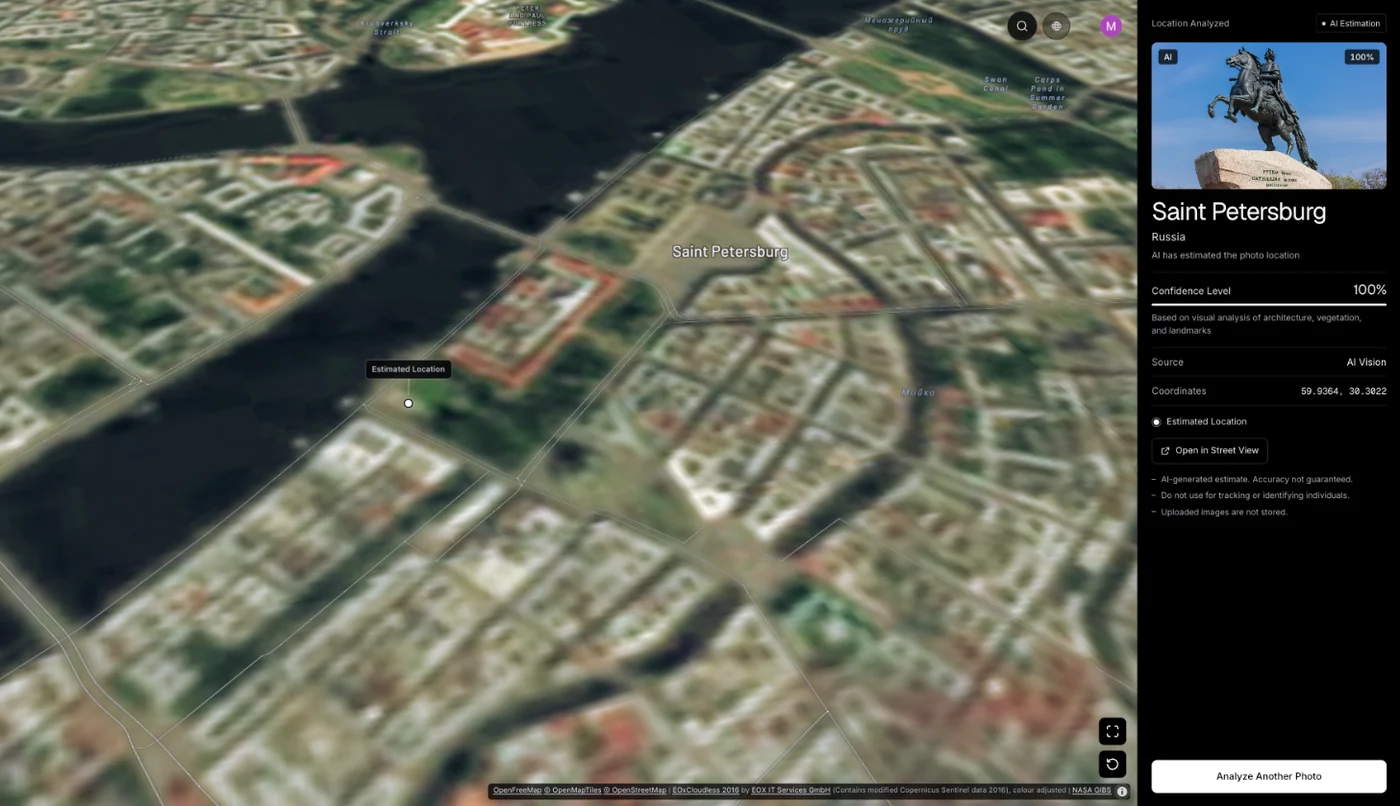
Upload a photo: GeoSpy AI reads its GPS data if it has any, and otherwise estimates the place from what it shows.
Statues are easier to identify than most things in photographs, because they were made to be remembered. Someone commissioned them, named them and usually carved that name into stone or cast it in bronze. The hard cases are photos taken from behind, from far away, or cropped so that the base is missing. If the photo shows the square or street around the statue, AI that reads the surroundings can suggest the city before you start.
This guide is about statues and monuments. For buildings and famous sights in general, see how to identify a landmark from a photo; if you need the city around the statue, how to identify a city from a photo covers the street-level clues.
What does the base of the statue say?
Start with the pedestal. Most public statues carry the subject’s name, a dedication, a date or the sculptor’s signature, and bronze casts often show a foundry mark. Even a Latin dedication or a date in Roman numerals narrows the search to one person and one year.
Zoom in on every side of the base you can see. Transcribe the text exactly, keep the original spelling and search it in quotes. Latin inscriptions are common on older monuments: the Bronze Horseman in Saint Petersburg reads “Petro Primo Catharina Secunda MDCCLXXXII”, Catherine the Second to Peter the First, 1782, and repeats the dedication in Russian. If you cannot read the script, a phone’s camera translation feature can read and translate it for you. Look lower down too: sculptors often signed the plinth near the feet, and foundries stamped their name on the bronze.
Who or what does the statue show?
Identify the figure before the place. A rider, a saint with a symbol, a political leader, an animal or an abstract form each belong to particular traditions. Once you know who is shown, search for statues of that person and compare the pose.
- Attributes name religious figures: Saint Peter holds keys, Saint George fights a dragon, and the winged lion stands for Saint Mark and for Venice.
- Clothing and props date a person: a tricorn hat, a toga, a military greatcoat or a business suit each place the subject in an era.
- Pose tells you the purpose: a leader with a raised arm is a political monument, a seated writer is often a literary memorial, a figure on a column is often a national hero.
- Animals are clues of their own: lions guarding a door, a famous dog, or a horse with a rider, which brings us to a popular myth.
Do the hooves of an equestrian statue mean anything?
Not reliably. A popular legend says a rearing horse means the rider died in battle, one raised hoof means wounds, and four hooves on the ground a death outside battle. Many statues break that rule, so use the rider, the base and the setting instead.
The legend is widespread enough that people use it to guess who a rider was. It works for a handful of monuments and fails for many others, so it cannot narrow a search. A rider is better identified by uniform, regalia and the inscription. Equestrian statues of rulers and generals are also well cataloged, which makes them among the easiest statues to look up once you know the country.
Can the material and style point to a country?
They help rank candidates. Green-patinated bronze, white marble, gilded figures and painted concrete belong to different eras and budgets, and many countries have their own sculptural schools. Material rarely names a city on its own, but it can date a work and rule places out.
| What you see | What it suggests |
|---|---|
| Green bronze on a tall stone pedestal | A 19th- or early 20th-century civic monument, common in Europe and the Americas |
| Gilded figure | A prestige commission: gilding is costly and usually reserved for important monuments |
| White marble | Older or religious work; classical subjects; Italy and the Mediterranean in particular |
| Large concrete or steel figures | Mid-20th-century monuments, including many in former socialist countries |
| Painted fiberglass or resin | Recent mascots and sculpture trails in parks and shopping streets |
Where can you look up public statues?
Use catalogs built for the job: Wikimedia Commons categories of statues by city, OpenStreetMap entries tagged as statues, and national inventories such as the Smithsonian’s art inventories in the United States, which describe more than 400,000 artworks. Search your candidate city, then match the pose.
Wikimedia Commons groups photos into categories such as statues in a given city, so you can scroll through a town’s photographed statues in minutes. OpenStreetMap marks memorials that take the form of a statue with their own tag, which means the map itself can list the statues mapped in a town. In the United States, the Smithsonian American Art Museum’s Inventory of American Sculpture covers works from the colonial era to today. Local tourism sites and public art programs fill the gaps for recent works.
How do you search for a statue with images?
Crop the photo to the statue, run it through two or three reverse image search engines, and add the city name if you have a guess. Famous statues match at once; lesser-known ones match when someone has photographed them from a similar angle.
- Step 1Crop to the statueRemove people and clutter so the engine focuses on the figure and the base.
- Step 2Try several enginesGoogle Lens, Bing and Yandex index different photos; our comparison of reverse image search tools shows where each is strongest.
- Step 3Search the setting tooIf the statue alone returns nothing, search the building or skyline behind it and look for statues on that square.
- Step 4Confirm on the mapFind the square in Street View or published photos and check that the statue, pedestal and background all match.
Can AI tell where a statue photo was taken?
It can estimate it. GeoSpy reads GPS from the file when it is there; without it, an AI model estimates the place from the statue, the buildings and the street around it, and returns a location with a confidence score on a map. Treat it as a lead and confirm it with the base and the catalogs.
An AI estimate is most helpful when the statue itself is unfamiliar but the setting is not: a square, a façade or a skyline is often recognizable even when the figure is not. Upload the photo, then check the answer against the inscription and a catalog of that city. Seeing the full result is a paid feature on the web. For how these models read a scene, see how AI geolocation works.
Frequently asked questions
- Is there an app that identifies statues?
- Visual search apps such as Google Lens recognize many well-known statues. For lesser-known ones, the inscription on the base and a public art catalog of the city usually work better.
- How do I find the name of a statue from its inscription?
- Transcribe the text exactly, convert any Roman numerals to a year, and search the words in quotes with the year. Translate Latin or other languages before searching if the original returns nothing.
- What does it mean when a horse statue has one leg raised?
- There is a popular legend that it shows the rider was wounded in battle, but many statues do not follow it. Identify the rider from the uniform, the base and the location instead.
- How can I find out who made a statue?
- Look for a signature near the base or the feet and a foundry mark on bronze. Catalogs such as the Smithsonian’s inventory in the United States and Wikimedia Commons pages usually name the sculptor.
- Can I identify a statue in an old photo?
- Yes, but check whether it still stands: statues are moved, replaced and removed. Our guide to finding where an old photo was taken covers dating and comparing old scenes.
Sources
- Bronze Horseman — WikipediaThe Latin and Russian inscription, unveiled 1782; the Thunder Stone pedestal weighs about 1,250 tons.
- Equestrian statue: hoof-position symbolism — WikipediaDescribes the hoof-position belief as an urban legend.
- Inventories of American Painting and Sculpture — Smithsonian American Art MuseumMore than 400,000 artworks described; the sculpture inventory has no cut-off date.
- Tag:memorial=statue — OpenStreetMap WikiHow OpenStreetMap marks a memorial in the form of a statue.
Keep reading
How to Identify a Landmark From a Photo
Name a landmark or building from a picture with Google Lens, iPhone Visual Look Up, Bing or Yandex, and what to do when the building is not famous.
· 12 min read
Where Is This Beach? How to Find a Beach From a Photo
Where is this beach? Read the sand, rocks, water, lifeguard flags and signs in the photo, then match the coastline on a map to name the exact beach.
· 7 min read
How to Identify a City From a Photo
What city is this photo from? Read the skyline, signs, transit, plates and plants, then confirm on a map. A step-by-step method, plus AI for no-GPS photos.
· 9 min read
The Best Reverse Image Search Tools, Compared
Google Lens, Yandex, Bing and TinEye do different things. A comparison of what each engine is good at, and when to reach for AI geolocation instead.
· 6 min read