
How to Identify a Church or Cathedral From a Photo
By Sam D. · · 6 min read
Short answer
To identify a church from a photo, work out its tradition and style first: Catholic, Protestant or Orthodox; Romanesque, Gothic, Baroque or modern. Then read the material, the tower and the setting, look for a name board or a dated stone, and check church maps, Wikimedia Commons and a reverse image search for the city you suspect.
Find where your photo was taken
Upload a photo: GeoSpy AI reads its GPS data if it has any, and otherwise estimates the place from what it shows.
Churches are some of the best-documented buildings in the world. Almost every one has a name, a date and a parish, and the famous ones have been photographed from every side. That makes them easy to identify once you know where to look, and the building itself tells you where to look. If you want a head start on the city, you can find the location of a photo with AI and then use the clues below to confirm it.
This guide covers churches and cathedrals. For other buildings, see the building clues guide; for statues outside a church, see how to identify a statue.
What church is this, and which tradition built it?
Start with the tradition, because it shapes the building. Onion domes and three-bar crosses point to Orthodox churches in Eastern Europe; statues and side altars to Catholic ones; a plainer hall built around the pulpit to Protestant ones. Inside, an icon screen called an iconostasis means Eastern Orthodox.
- Orthodox: onion or helmet domes, often gilded or painted; a cross with extra bars; inside, a wall of icons separating the altar from the nave.
- Catholic: statues of saints, side altars, confessionals and, on many older churches in Italy and Malta, the Latin abbreviation D.O.M. above the door.
- Protestant: plainer interiors, a prominent pulpit and hymn number boards; Reformed churches in particular have few or no images.
- Other traditions: Armenian and Georgian churches have tall conical domes; Ethiopian and Coptic churches have their own art and plans. Each narrows the map to a few countries.
Which architectural style is the church?
Style gives the century and often the region. Round arches and thick walls mean Romanesque; pointed arches, rib vaults and tall windows mean Gothic; domes, curves and gilding mean Baroque. Red-brick Gothic belongs mostly to the lands around the Baltic Sea, where building stone was scarce.
| Style | How to recognize it | Where it is common |
|---|---|---|
| Romanesque | Round arches, thick walls, small windows | Western and Central Europe, 11th–12th century |
| Gothic | Pointed arches, rib vaults, flying buttresses, large stained-glass windows | France, England, Germany, Spain and beyond |
| Brick Gothic | Gothic shapes built in red brick, few sculptures | Northern Germany, Poland, the Baltic states, Scandinavia |
| Baroque | Domes, curved façades, rich gilding and painted ceilings | Italy, Austria, southern Germany, Spain, Latin America |
| Russian and Ukrainian Orthodox | Clusters of onion domes, bright colors | Russia, Ukraine, Belarus and their neighbors |
| Spanish colonial | Whitewashed or stone façades, bell gables, thick adobe walls | Mexico, the US Southwest, Peru, the Philippines |
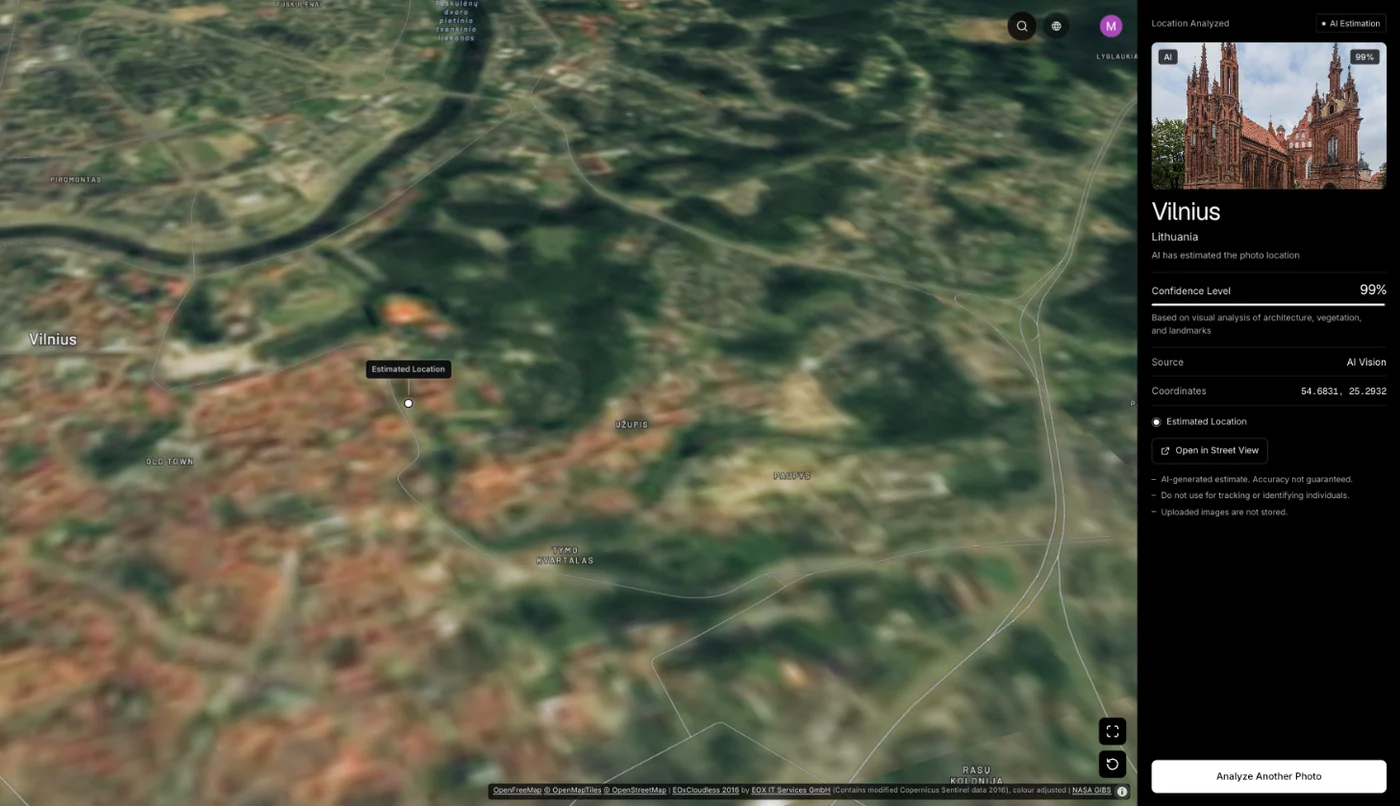
St. Anne’s Church in Vilnius shows how specific a style can be: finished in about 1500 and built of red brick, it is a textbook example of Brick Gothic. Treat style as a strong hint, not proof. Gothic Revival churches were built all over the world in the 19th century, and onion domes also crown churches in Bavaria, Austria and northeastern Italy. When style and other clues disagree, trust the clues that are harder to copy: inscriptions, signs and the street around the church.
What do the material and the tower reveal?
Material follows local supply. Red brick suggests northern lowlands, pale limestone much of France and England, whitewash the Mediterranean and Latin America, timber Scandinavia and northern Russia. Towers differ too: a separate bell tower is typical of Italy, twin west towers of large Gothic cathedrals.
Look at the top of the tower. A tall needle spire, a stepped helmet, an onion cap, a flat roof with a balustrade or an open bell gable each belong to particular regions. Count the bells you can see, note the clock face and any weather vane, and check whether the tower stands apart from the nave. The same tower shape often repeats across the churches of one region, which helps you search a whole diocese at once.
Is the church’s name written somewhere?
Often. Many churches have a notice board at the gate with the church’s name, the denomination and service times, a foundation stone with a date, or a dedication carved over the main door. Zoom in on boards, plaques and the area around the portal.
Notice boards are common outside churches in English-speaking countries and name the church outright. Elsewhere, a dedication over the door names the saint, and the saint plus the city is usually enough. Inside, look for printed leaflets, donation boxes and memorial plaques: they often carry the parish name. A date on a foundation stone also helps when you compare candidates.
Where can you look up churches by place?
OpenStreetMap marks places of worship, usually with their religion and denomination, so you can list the churches of a whole town. Wikimedia Commons sorts photos into categories of churches by city, and map apps show photos for each one.
- Step 1List candidates on the mapSearch the candidate town for churches, or query OpenStreetMap places of worship there, filtered by denomination if you know it.
- Step 2Compare photosOpen the Commons category for churches in that city and compare towers and façades.
- Step 3Search with imagesCrop to the church and run a reverse image search; famous churches match at once.
- Step 4Confirm the viewpointCheck Street View or published photos of the square to see that the church and its neighbors line up.
Can AI tell where a church photo was taken?
It can estimate it. GeoSpy reads GPS from the file when it is there; without it, an AI model estimates the place from the church, the street and the skyline, and returns a location with a confidence score on a map. Use it as a lead, then confirm it with the clues above.
An AI estimate is most useful for a village church or a plain parish church that looks like a thousand others: the houses, the street and the light around it often say more than the church itself. Upload the photo and check the answer against your reading of tradition and style. Seeing the full result is a paid feature on the web. For how such models reason, see how AI geolocation works.
Frequently asked questions
- Can Google Lens identify a church?
- It recognizes famous churches and cathedrals well. For a small parish church it often shows similar buildings, so use the tradition, style and any written name as well.
- What is the difference between a church and a cathedral?
- A cathedral is the church that holds the seat of a bishop, which makes it the central church of a diocese. Size does not decide it: some cathedrals are smaller than nearby churches.
- Can I identify a church from an interior photo?
- Often. The altar, the ceiling, the windows, the organ and any icons are distinctive, and many churches publish interior photos. An icon screen in front of the altar means an Eastern Orthodox church.
- What does D.O.M. mean on a church?
- It abbreviates the Latin Deo optimo maximo, “to God, most good, most great”. It appears on many Renaissance-era churches and tombs, particularly in Italy and Malta.
- How do I find a church in an old photo?
- Compare the tower and façade with today, since churches are often extended or rebuilt. Our guide to finding where an old photo was taken explains how to date and match old scenes.
Sources
- St. Anne’s Church, Vilnius — WikipediaA Flamboyant and Brick Gothic church completed around 1500 in Vilnius Old Town.
- Brick Gothic — WikipediaCommon around the Baltic Sea, in regions without resources of standing rock.
- Onion dome — WikipediaAssociated with the Russian Orthodox Church, also found in Bavaria, Austria and northeastern Italy.
- Tag:amenity=place_of_worship — OpenStreetMap WikiHow OpenStreetMap tags places of worship, with religion and denomination.
Keep reading
What Is This Statue? How to Identify Statues and Monuments
What is this statue? Read the inscription on the base, identify the figure, check public art catalogs and run an image search to name it and find its place.
· 7 min read
How to Identify a Landmark From a Photo
Name a landmark or building from a picture with Google Lens, iPhone Visual Look Up, Bing or Yandex, and what to do when the building is not famous.
· 12 min read
Where Is This Building? 7 Clues That Give Its Location Away
Where is this building? Read architecture style, materials, roof pitch, windows, signs, street furniture and climate to place an ordinary building.
· 7 min read
How to Identify a Bridge From a Photo
What bridge is this? Name its type, count spans and towers, read its color and setting, then check bridge databases and satellite view to name the bridge.
· 6 min read