
How to Identify a Location From a Night Photo
By Sam D. · · 7 min read
Short answer
To identify a location from a night photo, use the clues that survive the dark: lit landmarks and skylines, the color of the street lights, illuminated signs, which side the car lights are on, the Moon and stars, sky glow and seasonal decorations. Then match the shapes of the scene to daytime imagery of your candidate places.
Find where your photo was taken
Upload a photo: GeoSpy AI reads its GPS data if it has any, and otherwise estimates the place from what it shows.
Night photos hide most of what makes a daytime photo easy to place: vegetation, road markings, house colors and the landscape all fade into black. What remains is light, and light is more informative than it looks. Cities light their landmarks in their own ways, street lamps differ by era and country, and the sky itself carries information about latitude. If you want a first guess before working through the clues, an online photo location finder gives you a city to test.
The seven clues below are specific to photos taken after dark. For the general method, see how to find where a photo was taken; for skylines and street scenes in daylight, how to identify a city from a photo covers the rest.
Which lit landmarks and skylines can you recognize?
Famous buildings are floodlit after dark, often in the same way every night, so a lit outline can be as recognizable as the building by day. Skylines are even better: the pattern of towers and their lit tops is unique to each city. Start with the brightest, tallest object in the frame.
Floodlighting picks out exactly the features a city is proud of: domes, towers, bridges and façades along a river. Budapest’s Parliament, a neo-Gothic building 268 meters long on the bank of the Danube, glows gold at night and is visible from across the river. Tall towers often have lit crowns or changing colors for holidays, and a city’s skyline at night is often photographed from the same few viewpoints, which makes a reverse image search more likely to hit.
What does the color of the street lights tell you?
It hints at the type of lamp, and through that at place and era. Low-pressure sodium lamps give a monochrome yellow, high-pressure sodium a warm orange, and LEDs a white or bluish light. Many cities have been replacing sodium lamps with LEDs, so color also helps date a photo.
Sodium lamps emit light near a wavelength of 589 nanometers, which is why older street lighting looks so uniformly yellow or orange in photos: colors are hard to tell apart under it. White LED light shows colors more faithfully. A street under orange light with a neighboring street in white light suggests a city in the middle of a conversion. Use this as a supporting clue only, because cameras shift colors and many places mix lamp types.
Can lit signs and windows give the place away?
Yes, often more than in daylight. Illuminated shop signs, neon, menus in windows and lit billboards are bright enough to read, and they carry language, script, phone number formats and brand names. One readable sign can name the country and sometimes the street.
Zoom in on every glowing rectangle. The script narrows the region at once, a business name can be searched with a candidate city, and chains that exist only in some countries narrow it further. Even unreadable windows help: the shape and spacing of lit windows, balconies and shutters reflect local building styles, the same way they do in the building clues guide.
What do traffic lights and car lights reveal?
Car lights show the driving side: white headlights come toward the camera and red taillights move away, so you can see which lane is which. Traffic signals add more, because their shape, mounting and pedestrian symbols follow national standards.
On a two-way road, check whether oncoming white lights are on the left or the right. In left-hand traffic countries, such as the United Kingdom, Japan, India and Australia, they appear on the right of a driver’s view. Long-exposure photos turn cars into streaks of white and red, which shows the lanes even more clearly. Traffic lights follow national standards too: how they are mounted, their shape and the pedestrian symbols are worth comparing with photos from your candidate countries.
Can the Moon and stars show the hemisphere?
Sometimes. The Moon’s phases appear rotated by 180 degrees from the Southern Hemisphere compared with the Northern, and the height of the North Star above the horizon roughly equals the observer’s latitude. Recognizable constellations and the Milky Way’s position narrow it further.
Sky clues need a photo that shows both the sky and the horizon. If the North Star is visible, its elevation gives the latitude roughly, and if it never appears while the Southern Cross does, you are probably south of the equator. A crescent Moon lit on the left or the right means different phases in the two hemispheres, so compare it with a phase calendar for the date if you know it. For daytime shadows, the same reasoning is explained in how to find location from shadows.
Do sky glow and auroras narrow the latitude?
Auroras are a strong clue: they are seen most often in a band centered on 67 degrees north and south, so a photo with the northern lights usually comes from places like Iceland, Norway, Finland, Canada or Alaska. Sky glow over a horizon shows where a town lies.
A green or red glow in the sky narrows the search to high latitudes, with the southern lights visible from places such as New Zealand, southeastern Australia and Patagonia. In ordinary photos, the orange or white dome of light on the horizon marks a town or city, and its direction relative to the scene can help pin the viewpoint once you have candidates.
What do seasonal lights and events say?
Decorations date a photo more than they place it, but some are local. Christmas markets, lantern festivals and city light festivals run in particular places at particular times, and their designs are well documented. Search the decoration with the season and compare.
A lit market with wooden stalls, a street hung with paper lanterns or a projection on a cathedral front all point to events with dates and websites. Once you know the event, the location usually follows from its program. These clues work best combined with a sign or a landmark that confirms the city.
How do you confirm the location of a night photo?
Compare shapes, not lights. Street View and satellite images are taken by day, so match rooflines, towers, bridges, the curve of a road and the shoreline. Once the outlines agree, check that the lit features sit where buildings and lamps stand in the daytime view.
- Step 1Brighten a copyRaise the exposure of a copy of the photo to see shapes in the shadows; work on the copy, not the original.
- Step 2List the cluesLandmarks, lamp color, signs, driving side, sky and decorations, with how sure you are of each.
- Step 3Search with imagesRun the photo through a reverse image search; night skylines are often photographed from the same viewpoints.
- Step 4Match outlines by dayOpen the candidate place in Street View or 3D satellite view and compare rooflines and the shape of the street.
Can AI tell where a night photo was taken?
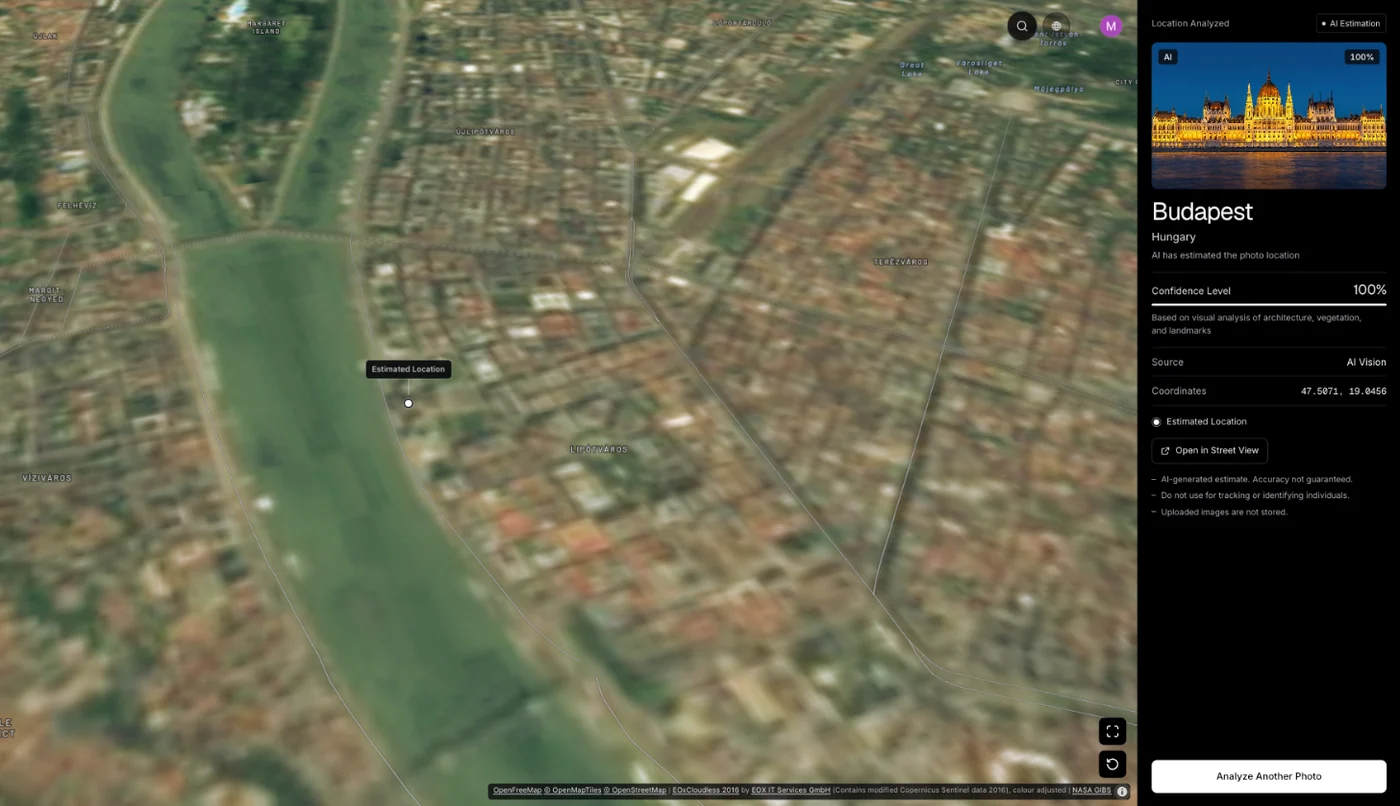
It can estimate it. GeoSpy reads GPS from the file when it is there; without it, an AI model estimates the place from what the photo shows, lit buildings and signs included, and returns a location with a confidence score on a map. Use it as a lead and confirm it with the clues above.
Night photos give any reader less to work with, but a lit landmark or a readable sign is often all it takes. Upload the photo and check the answer against your own list of clues, especially the driving side and the script. For how these models weigh evidence, see how AI geolocation works.
Frequently asked questions
- Can Google Lens identify a place from a night photo?
- Yes for famous lit landmarks and skylines, which are photographed at night all the time. For an ordinary street at night it struggles, so read the signs and lights and compare with daytime imagery.
- Why are some street lights orange and others white?
- Orange and yellow light comes from sodium lamps, white light usually from LEDs. Many cities have been replacing sodium lamps with LEDs, so the color hints at both the place and the period.
- Can I tell the hemisphere from a photo of the Moon?
- Partly. The Moon appears rotated by 180 degrees from the Southern Hemisphere, so the lit side of a crescent means different phases in the north and the south. You need the date or another clue to be sure.
- How do I find where a fireworks photo was taken?
- Look at what the fireworks light up: the skyline, a bridge or the waterfront. Big displays happen on known dates in known places, so the date plus the skyline usually identifies the event.
- Does a night photo still have GPS data?
- The original file can, if the camera saved location; a photo metadata viewer shows it in seconds. Copies shared through most apps lose it; see why photos lose location when shared.
Sources
- Sodium-vapor lamp — WikipediaLight near 589 nm; low-pressure lamps are near-monochromatic yellow; the gradual phase-out to LED.
- Polaris — WikipediaThe star’s elevation above the horizon gives the approximate latitude of the observer.
- Aurora — WikipediaThe auroral zone is a band about 6 degrees wide centered on 67 degrees north and south.
- Hungarian Parliament Building — WikipediaNeo-Gothic, 268 meters long, completed in 1904; the largest building in Hungary.
Keep reading
How to Identify a City From a Photo
What city is this photo from? Read the skyline, signs, transit, plates and plants, then confirm on a map. A step-by-step method, plus AI for no-GPS photos.
· 9 min read
How to Find Location From Shadows in a Photo
Shadows will not give you a country, but they settle hemisphere, time of day and season — which is often exactly what separates two candidate answers.
· 4 min read
How to Identify a Train Station From a Photo
Which train station is this? Read the name signs, the operator’s sign design, the trains, the track gauge, the roof and the language, then check a rail map.
· 7 min read
How to Find Out Where a Photo Was Taken
Four ways to work out where a photo was taken: GPS metadata, reverse image search, AI geolocation and reading the image itself. What each can and cannot do.
· 7 min read